
Task Bar Cube Review: Idle Systems, DLC & Launch Concerns
A source-based Task Bar Cube launch assessment covering idle combat, equipment, paid advantages, and acknowledged player concerns.

Task Bar Cube Gameplay Walkthrough LONGPLAY 4K 60FPS PC - No Commentary — Velirplay
General game footage used as fallback media. This is not a keyword-specific tutorial or device benchmark; use the cited references for factual claims.
Launch Verdict: An Appealing Concept With Reasons for Caution
This Task Bar Cube review starts with the central tradeoff: automatic battles in a compact desktop window, backed by paid power and storage upgrades. Those purchases matter because they affect progression and inventory management. This source-based Task Bar Cube review examines the documented features and launch concerns so you can decide whether the free download deserves your attention.
Developed and published by DarkRook Interactive, the game launched on October 25, 2026. The supplied evidence covers the global Steam Windows release, reviewed October 26. Native macOS and Linux support are not listed.
I did not perform hands-on testing. This assessment draws on official listings, promotional screenshots, community reports, and developer replies; no numbered patch was verified.
The initial recommendation is conditional: consider trying the free base game if you enjoy incremental growth, collecting equipment, and managing several upgrade systems. Delay purchases until you know whether its interface and progression suit you.
The official Task Bar Cube Steam listing advertises automatic hero combat, a compact taskbar view, and a full-screen option. That format offers an appealing way to keep an RPG nearby while doing other things. Whether it stays unobtrusive requires actual desktop use.
Combat and Equipment Offer Several Progression Paths
The strongest feature on paper is the range of ways to improve your team. The store advertises five classes, individual combat skills, heroes, pets, a talent tree, and Cube upgrades involving Prestige.
Official screenshots separate Character Information, Character Skills, and Talent Tree panels. Displayed attributes include attack speed, critical chance, life steal, defense, and evasion, suggesting several dimensions to character development. Their sample values cannot establish class balance or build quality.
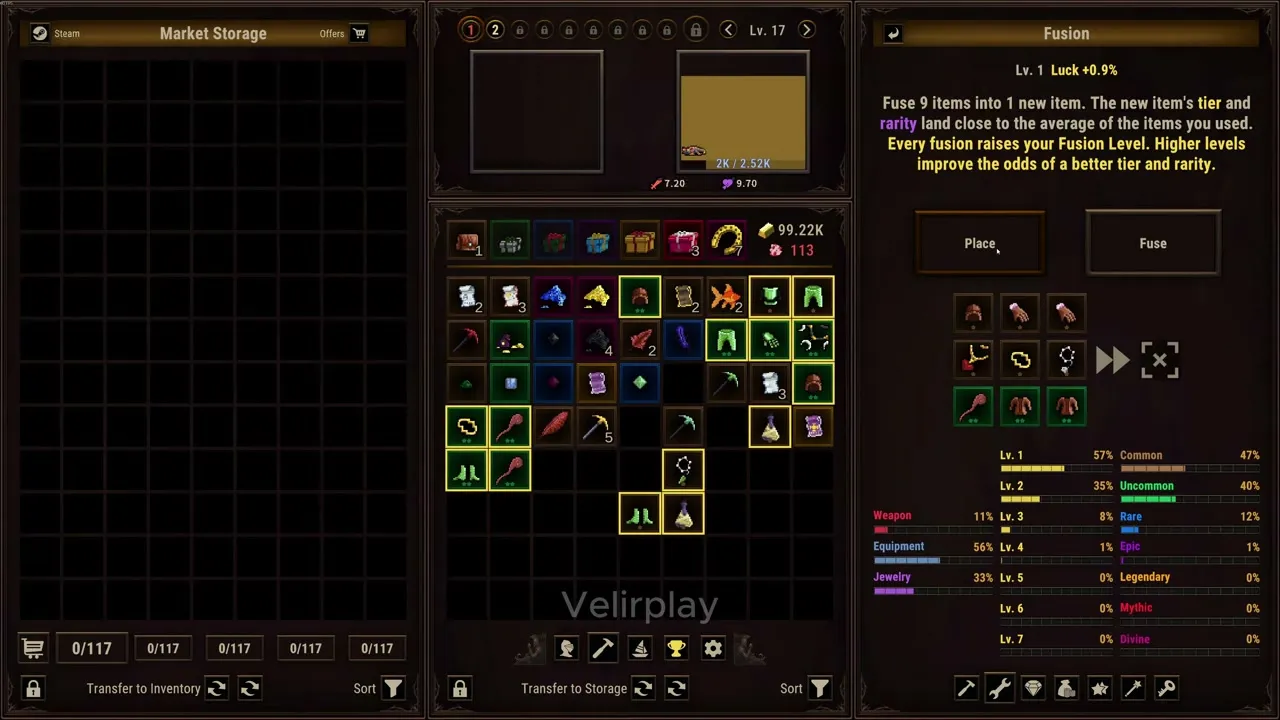
For this Task Bar Cube review, equipment provides the clearest example of documented complexity. Seven rarities run from Common through Divine, with seven tiers per item. Several upgrade methods serve different purposes:
| Equipment system | Advertised behavior | Decision it raises |
|---|---|---|
| Rarity Upgrade | Compatible items of matching type and rarity produce the next rarity | Which duplicates should you retain? |
| Fusion | Nine items produce a new item, with tier and rarity near the input average | Which inputs are worth combining? |
| Tier Upgrade | Attempts raise tier while retaining rarity; coins are spent even on failure | Is the attempt worth its displayed cost and chance? |
| Gem socketing | Listed as an equipment feature | Check the in-game rules before committing gems |
Rarity upgrading is described as deterministic and retains the highest input level. Its six steps require three, four, five, six, seven, and eight compatible items respectively. The promotional example combines six Epic crossbows into one Legendary crossbow.
Fusion introduces a different calculation. Higher Fusion Level is advertised to improve the chance of a better result, but the evidence supplies no exact averaging formula or universal odds.
Tier upgrades add resource risk: they consume Iron, Gold, and Platinum Coins, including on failed attempts. The screenshot does not establish item destruction, downgrades, or socket preservation.
These distinctions suggest meaningful inventory decisions. They also explain why clear tutorials matter. Before combining valuable equipment, read the relevant panel rather than assuming every upgrade works alike.
Village Activities Expand the Loop Beyond Battles
A useful Task Bar Cube review also needs to consider what happens outside combat. Farming, hunting, mining, the merchant, the library, and the animal shelter give the advertised progression loop additional activities.
Their resources have distinct roles:
| Activity | Documented progression | Resource distinction |
|---|---|---|
| Farm | Harvesting grants produce and Farm XP; higher levels improve speed and rewards | Fertilizer improves produce level and amount |
| Hunting | Fish or box catches grant Hunting XP; levels unlock fishermen and fish types | Hunting Dust improves slot rarity and stock |
| Mining | Mining grants Mining XP; levels unlock mines and pickaxe slots | Matching pickaxes are consumed; Ore Dust improves slots |
| Merchant | Ores are exchanged for rewards; completing rounds advances Merchant Level | More valuable ores take longer and pay more |
The library and animal shelter strengthen different parts of your roster. Library shelf upgrades use Parchments, while Star Dust improves shelf level benefits and upgrade chances. Shelter upgrades use Feathers, with Parchment Dust serving its leveling system.
Library bonuses target character attributes and different equipment categories; the explanatory text excludes gem stats from item bonuses. Shelter bonuses apply to all pets, with shelves affecting attack or defense attributes.
This breadth could appeal to players who enjoy maintaining several activities between combat checks. It could also create substantial menu work. The evidence does not establish how frequently these systems demand attention.
A practical starting approach is to learn each currency’s stated purpose before spending it. There is no verified conversion chain connecting every production material to every upgrade resource, so similar names should not be treated as interchangeable.
Paid Packs Change Power, Capacity, and Reward Limits
Monetization is central to this Task Bar Cube review because the advertised purchases include stronger units and progression benefits. The base game is free, but the optional packs go beyond appearance.
The following summarizes developer-advertised benefits, without assuming tested delivery or stacking:
| Paid option | Principal advertised benefit | Other listed benefits |
|---|---|---|
| Character Pack | Ten exclusive heroes with 30% higher base stats | Active pack heroes add gold bonuses; additional gold, capacity, chest-limit, and AFK-duration benefits |
| Support Package | Ten exclusive pets with 30% higher base stats | Active pack pets add gold bonuses; additional gold, capacity, chest-limit, and AFK-duration benefits |
| Inventory Package | All listed storage categories and five pages in each | Steam inventory pages 2–5, plus capacity, chest-limit, and AFK-duration benefits |
| Premium Battle Pass | A pictured 30-day package with reward-rate boosts | Advertised gold boost, daily rewards, and a higher daily Steam chest limit |
The Support Package listing calls its contents a Companion Pack, while the Inventory Package description uses Storage Pack. Their advertised contents provide the useful distinction.
The Character Pack lists 5% additional gold per active pack hero, capped at 50%. The pet package lists 3% per active pack pet, capped at 30%. Both also advertise a permanent 10% bonus to battle and AFK gold.
Each of the three DLC listings advertises an additional 50 daily Steam chest capacity, 50 more battle boxes, oysters, and starfish, and one extra hour of AFK earnings. Cross-pack stacking has not been verified.
The Battle Pass screenshot advertises 50% increases to Box, Oyster, and Starfish drop rates, plus 30% more gold. Its Box Drop Rate wording does not establish improved Steam chest levels or item rarity.
Likewise, increasing the daily chest limit by 50 means greater capacity, rather than 50 immediate rewards. The base store advertises a random Steam chest every five minutes of play, subject to account limits.
These purchases clearly advertise advantages. Whether free progression feels satisfying remains a hands-on question. Try the base loop first, then assess whether you enjoy it before paying to expand it. Current prices and Battle Pass billing behavior are not established by the supplied evidence.
Launch Complaints Affect the Desktop Companion Pitch
Community reports identify friction that matters particularly for a game designed to sit alongside other work. The available review selection includes criticism of confusing systems, frequent offers, and storage monetization. Another player experience praises incremental growth, collecting gear, and village management.
Those observations describe individual experiences, not a representative player verdict.
| Launch concern | Available evidence | Practical implication |
|---|---|---|
| Frequent purchase offers | A player reports many early pop-ups; the developer acknowledges excessive beginner offer frequency | Check whether interruptions undermine the background-game appeal |
| Combat effects | A player requests an option to disable animations and effects; the developer promises one | Verify the setting exists if this matters to you |
| Suspicious rankings | Community reports flag implausible entries; the developer promises invalid-entry removal | Treat ranking integrity as unresolved |
| System clarity | Some community reviews describe confusing mechanics | Judge whether explanations make resource spending understandable |
Developer responses show acknowledgment, but the supplied evidence confirms neither an offer-frequency fix nor a shipped effects toggle. The ranking reply also does not independently prove that suspicious entries were removed.
ACT League and Online Ranking should remain distinct. Promotional material shows boss fights in ACT League and a separate ranking panel. The store explicitly says ACT League boss bonuses survive Prestige; that does not establish what every other reset preserves.
The judgment in this Task Bar Cube review is therefore cautious interest. Its documented systems offer considerable variety, while paid advantages and acknowledged interruptions deserve scrutiny.
A hands-on follow-up would need to establish desktop responsiveness, resource use, interface readability, free-player pacing, and whether later progression adds worthwhile decisions. Uncapped levels alone cannot demonstrate lasting depth.
For now, evaluate it through three concrete checks: does the compact window suit your desktop, can you understand upgrades before spending resources, and is progression enjoyable before buying anything?
What should you read next?
Continue with the beginner guide. Start by watching automatic combat, inspecting one affordable upgrade, and comparing what changes.
Continue with the DLC comparison. Compare Character Pack, Support Package, and Inventory Package by their listed benefits.
Continue with the known issues overview. Launch reports cover missing Steam chests, Battle Pass allowances, promotional interruptions, combat effects, rankings, and characters staying at level one.
FAQ
Is Task Bar Cube free to play?
Does it earn rewards while the game is closed?
Does Task Bar Cube support Steam Cloud?
Is it worth trying at launch?
Related Articles
chests
Task Bar Cube Steam Chests: Drop Rates & Daily Limits
Learn Task Bar Cube chest drop rates, the five-minute interval, DLC limit claims, and how daily caps differ from inventory space.
guide
Task Bar Cube Achievements: Goals & Milestone Tracking
Track 26 verified Task Bar Cube achievement goals, compare milestones, and distinguish Steam unlocks from daily quests and in-game rewards.
guide
Task Bar Cube Beginner Guide: Heroes, Gear & First Goals
Learn how heroes, pets, gear, village resources, Prestige, and optional packs fit together in Task Bar Cube, with practical first-session checks.
Was this helpful?
Thanks for the feedback!